
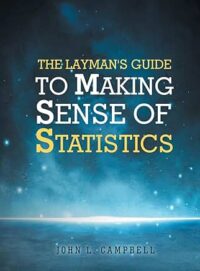
Title: The Layman’s Guide to Making Sense of Statistics
Author: John L. Campbell
Publisher: Kravitz and Sons LLC
ISBN: 979-8896392736
Pages: 78
Genre: Non-fiction / Mathematics
Reviewed by: Anthony Avina
Hollywood Book Reviews
Throughout the history of the world, knowledge has always been the ultimate quest which has driven humanity forward. The foundation of such pursuits often comes from scientific discovery, and in that discovery comes the evidence-based findings rooted in mathematics. More specifically, statistics play a major role in not only the world’s pursuit of knowledge, but of dictating social and public policy regarding everything from health and finances to public safety, and even laws.
In author John L. Campbell’s The Layman’s Guide to Making Sense of Statistics, he lays out a detailed guide to understanding the concepts behind statistical computation, from the history of statistics to the specific processes of observation. Rather than laying out specific mathematics in regard to gathering statistics, the author lays out a guide that speaks to both skilled statistic gatherers and newcomers alike to showcase the power stats have on the world.
A fast paced yet detailed guide, the author does a remarkable job of presenting statistics in a relatable and engaging way. The author’s writing style is that of an authority figure, with a firm understanding of statistics which inspires confidence in the readers as they seek out their own knowledge on this subject. The enlightening process of understanding both the history and statistical process was very engaging to get into, and the way the author relies less on graphs and equations and more on real life examples and scenarios to outline these statistics and facts about statistics is what makes this book so insightful.
For those who enjoy non-fiction readings on math, scientific theory, history, and of course statistics, this is the perfect book to dive head first into. The detailed analysis of situations and scenarios to exemplify the topics of this book is perfect for newcomers, such as the Whitman Sampler, which highlighted a businesses use of an assorted sampler box of chocolates to highlight their products, with the consumer collecting data and making observations about the quality of the chocolates this company offers being the same each and every time they purchase. This highlighted the process of data collection that fuels statistics for companies about consumers and products themselves and expertly wove these examples into the book to provide great insight and knowledge readers will be able to retain. Once more, the ability to return to this book time and time again makes this a great book of education regarding the statistics world, and makes this a book worth investing time in. This is a perfect companion for high school or college students, or anyone re-entering the world of numbers for work. I’ll be recommending it often.