
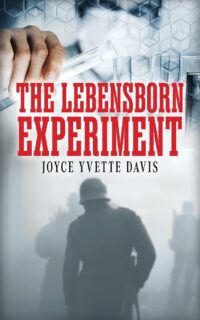
Title: The Lebensborn Experiment
Author: Joyce Yvette Davis
Publisher: Olympus Story House
ISBN: 978-1969422034
Pages: 232
Genre: Science Fiction
Reviewer: Liz Konkel
Hollywood Book Reviews
Sergeant Kapp Johnson awaits in captivity for the day of his execution within a castle dungeon hidden in the depths of the Black Forest. Darkness lurks inside this castle at the hands of Dr. Josef Weiss, who experiments on captives with a serum under the observation of a Nazi Colonel. When Hitler dies unexpectedly, the castle falls into chaos, which provides Kapp with the opportunity to escape and reunite with his all-black battalion. But he doesn’t come out unscathed, as he is mistakenly administered the drug and soon develops enhanced strength. He uses the newfound abilities to take out enemy soldiers. As he comes to terms with what he’s capable of, Kapp discovers he’s unable to die and that he’s not the only one who received the serum. Each of them experiences a different aspect of super-enhancement and must learn to accept their new capabilities.
The setting is crucial for how the story is told, as the events of WWII significantly impact the unfolding events for the various characters. This can be seen in Dr. Weiss’s experiments, but also through the chaos that occurs following Hitler’s death, and how this provides Kapp with an opportunity to escape. Author Joyce Yvette Davis employs these elements to create a tone that is suspenseful, historical, and occasionally somber. This is felt immediately with the opening image of a boy being experimented on with a serum, which creates this almost grotesque concept of a doctor who doesn’t seem to have any line he won’t cross. Several themes are woven into the premise, such as “true power comes from the ability to destroy” instead of just creation, which is particularly explored through the doctor and those injected with the serum. The various characters are impacted differently by these experiments, and what they do afterward is a reflection of the character types as they navigate through WWII.
Other themes include an exploration of retribution, with Kapp looking to retrieve his brother’s body and coping with what happened to him in the castle. Ultimately, this is a story about standing up and fighting back, although the concept of grief and loss is felt more strongly in multiple characters’ arcs. This creates a nice balance with the idea of retribution and is woven throughout from Dr. Weiss’s loss of his son to Kapp’s loss of his brother. The pain felt is often captured as if haunting the characters through memories and lingering pain. This forms ghosts from the past that follow, even when Kapp is free of the dungeon, and links the characters together in a unique way. It can be difficult to give historical settings, especially those with so much brutality, a sense of humanity, but Davis does so by creating well-rounded characters with realistic motivation, struggles, and pain. These are then explored through an otherworldly serum.
The character-driven narrative weaves through different perspectives, taking time with each of them for you to get a genuine sense of who they are and what they’re experiencing. The exposition is an important part of historical reads, with Davis using this like a secret weapon to build tension, further the story, and ground the characters in the reality of the time. Kapp is the most prominent character that you bond with; however, each character is given enough growth that you at least understand them, even if you don’t agree with their actions. This is ideal for those who enjoy super-human plots and historical reads, as the story blends these genres to create a fun ride from start to finish. A historical read that blends WWII, experiments, suspense, and super-enhanced abilities, The Lebensborn Experiment delivers a character-driven adventure that keeps you turning the page.