
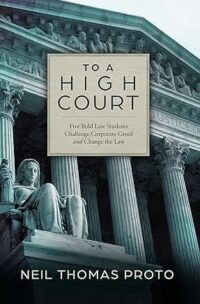
Title: To A High Court: Five Bold Students Challenge Corporate Greed and Change the Law
Author: Neil Thomas Proto
Publisher: FriesenPress
ISBN: 979-8350713282
Pages: 408
Genre: Law Legal Education / History
Reviewer: Anthony Avina
Hollywood Book Reviews
One of the major causes which has been a constant source of activism over the years has been environmentalism. Especially in the United States, when politics and social divides often draw lines in the sand in regard to whether a person believes in preserving the environment or is more in line with mankind’s aspirations of building commerce and commercial business ventures alike. Yet activism for this cause does not start and end with mere protests. There are many individuals who take on this fight for the cause, and that includes lawyers.
That is the drive of author Neil Thomas Proto’s book, To A High Court: Five Bold Students Challenge Corporate Greed and Change the Law. The book explores the creation of the group Students Challenging Regulatory Agency Procedures, or SCRAP. In 1971, during an age of anti-war protests and the Nixon Administration, a group of young lawyers helped find this group to tackle the greed of the corporate railroad companies and their impact on the environment. Utilizing notes and transcripts alongside photos of that time, the book explores the legal battle which the group fought to see the new environmental laws enacted against these corporations.
Immediately what stood out was how the author was able to write in a way that balanced his own personal experiences with the detailed, thorough exploration of documentation and photographs produced. The book not only brings a narrative experience to the author’s story by exploring the events and conversations that occurred during this time, but the author also does a great job of exploring specific context situations and questions regarding the law. The way the case brings about questions of who has the right to sue and who doesn’t in situations such as this was so insightful and engaging.
Readers who enjoy nonfiction stories, especially those who enjoy a blend of memoir storytelling and educational law insights, this is the perfect read. The themes the book explores, especially David versus Goliath, little guy versus the corporate machine style of story, made the author’s experiences more relatable and compelling. The author’s honest approach to the fact they were law students at the time of this case and the experiences of law school itself while working on a case of this magnitude that went all the way to the Supreme Court make this book feel so engaging, and was the kind of book that readers would be able to reference and return to time and time again.