
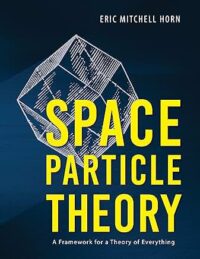
Title: Space Particle Theory: A Framework for a Theory of Everything
Author: Eric Mitchell Horn
Publisher: Luminare & Space Particle Press
ISBN: 978-1643884462
Pages: 232
Genre: Physics & Science
Reviewer: Jason Lulos
Hollywood Book Reviews
 Space Particle Theory: A Framework for a Theory of Everything is imaginative and scientific: an alternative view of physics that aims at a unified theory. It is a captivating and notably outside-the-box approach based upon space, speed, and time.
Einstein’s relativity theories and the quantum physics boom of the early 20th century were revolutionary. The later emergence of string theory delved further into the – what, how, and why our universe exists with paradoxically sound mathematics and strange phenomena. While there is some consensus among current physicists regarding these theories, there is much to be discovered, proven, and disproven. Eric Horn’s Space Particle Theory is an alternative theory that is speculative and intriguing in its mathematics and likewise seemingly strange phenomena. However, as Horn notes early on in this book, “physical phenomena have physical explanations.” Given the strangeness of quantum mechanics, one might suggest the strangeness of his theories is equally plausible. Horn offers space particle theory as a potential paradigm shift in the field.
Horn’s ideas are based mainly on the theories of Newton, Einstein, Fermi, Planck. But Horn diverts from said theories, when necessary, to describe a new framework explaining fundamental physical phenomena such as gravity, mass, space, time, movement, temperature, force, charge, and others. The gist of the applications of his theory, as I understand them, are as follows. There is no empty space. Space is made up of the smallest possible particles. The space particle (“spart”) is THE fundamental particle. The spart is massless and tessellates: meaning it changes shape to fit together so that there are no gaps: no empty space in space. Space particles flow into and out of hole-complexes which can be thought of as subatomic black holes. Flowing into these holes at light speed, they move from the observable “outer-verse” into an unobservable “inner-verse.” The flowing from outer to inner is the formation of matter. Since the universe is increasingly expanding, there is an inverse flow from the inner-verse to the outer-verse in the form of energy. This is analogous to “dark energy” and explains the net positive gain of “space” in our observable universe; hence, the universe is increasingly expanding. Around these hole-complexes, areas of consumption and creation different manifestations result: charge, space volume, gravity, and temperature. Horn proposes that all these interactions can be described in terms of speed of light and time. Thus, even gravity and matter themselves are products of space, speed, and time or ‘scat,’ Horn’s term.
There is a lot to digest in this book. Horn gives plenty of equations to back up his theories. And he presents extraordinarily useful analogies and mental illustrations to explain these theories. The notion that matter or gravity are the effects of a “volume of space moving through time” is beyond fascinating. For example, Horn notes that “Matter, an object with the property of mass, is touchable moving through space through time.” If so, this would completely change the way we think about matter.
The equations grow increasingly complex as the book goes on. But Horn’s explanations give brilliant analogies and images that help clarify things. Horn provides new terms and symbols to describe his theory. They allow for different ways to think about matter, space, and gravity. They also allow for interpretations to explain current theories. For example, the concept of the unobservable “inner-verse” may account for extra dimensions proposed in string theory. And the notion of this inner-verse could have further interpretations that correspond to, or diverge from, current quantum theories.
This is a fascinating book. Horn notes that some of it is speculative but so are some current quantum theories. The idea that fundamental space particles moving into and out of consumptive/creative hole-complexes resulting in all the physical phenomena we can observe is mind-boggling. I highly recommend this book simply for how thought-provoking it is. Perfect for science enthusiasts and forward thinkers, this book blends imagination with rigorous inquiry in the pursuit of ultimate understanding.